Monthly Archives: February 2010

Variable vs Fixed Interest Rates

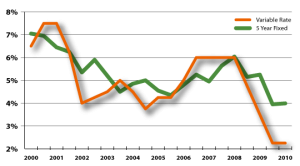
Variable vs Fixed Interest RatesThere has long been a discussion around whether variable rate interest rates for mortgages and loans are better than a fixed interest rate for these same financial vehicles. The debate always gets interesting when interest rates are about to change. Consumers get worried, about whether they will end up paying more interest because rates are rising and they did not lock in soon enough. Conversely, many consumers also worry that they are locked in too soon when interest rates start to fall. So what is the right strategy for consumers around this huge issue of fixed vs variable interest rates? After all, it is your money.

Variable vs Fixed Interest Rates

Well, we think there are a number of factors to consider and they will vary in importance for most people. As a result, it is a very personal decision based on the financial position you are in. The plans you have for the future regarding your property and your ability to deal with risk associated with changing interest rates. We will try to discuss the major issues and provoke people to think about their situation before they make a decision. At the present time in early 2016, it looks like interest rates will stay flat for another year. You can never tell when they will change, but that is what the experts are saying at the present time.

Some Background First

A fixed interest rate loan or mortgage is just that. The interest will not change for an agreed-to time frame, usually called the “term”. At the end of the term, the bank will offer you a new interest rate and term for your loan or mortgage if you have not already paid it off.

A variable interest rate loan or mortgage will vary in relation to the prevailing bank rate announced by the Fed in Canada or the United States. If it goes up, your bank is likely to increase the rate they charge you. If it goes down, they will lower the rate they charge as well.

When the bank rate is, let’s assume 2%, then the banks will charge you one or 2 % over that level. It depends on how competitive your bank is for a total interest rate of 3 or 4%.

Factors to Consider

These factors are not listed in any relation to importance, since individual consumers may rank them quite differently based on their personal situations.

Stress – Some people just cannot deal with the unknown of whether the interest rate will change and whether your monthly payments will change or not. If it keeps you up at night worrying, why put up with that, lock it in.

Changing Monthly Payments – each time the interest rate changes, the amount of interest you owe and the corresponding monthly payment will change. As long as it is going down it is ok, however, if the interest rate is going up and there is going to be a significant impact on your budget, then you may want to switch to a fixed interest rate loan or mortgage.

Planning to Sell

When you sign up for a fixed-rate mortgage you are saying that you will pay a certain amount for the life of the term based on the agreed-on interest rate. If you plan to sell during that period of time and the interest rates have fallen, the bank is going to charge you a penalty plus administration fees to discharge the mortgage when you sell your home. The penalty will roughly amount to the difference in your rate and the rate that the bank will lend the money out at the time you close. This can amount to thousands of dollars, so it is a good idea to think about this.

With a variable rate mortgage often you will only pay the administration fees to discharge the mortgage.

Saving Money – Variable rate loans and mortgages often have lower interest rates than the fixed rate loans and mortgages being offered by banks. This is only true at the time you take out the mortgage. Interest rates do change and they can go up and down, however, at the time you sign, the variable interest rate is usually lower than the prevailing fixed interest rates. This is an excellent way to save money especially if you feel that for the foreseeable future, interest rates are not likely to change much.

Volatile Interest Rates

In periods of high inflation or in periods of economic downturns and depressions/recessions, the interest rate that is quoted by the banks can change often. During periods of economic growth and high inflation interest rates tend to rise. During recessions and depressions, interest rates tend to decline in order to stimulate the economy and get things moving.

Consumers should take this forecast of interest rate volatility into account when they are making their decision along with the other factors mentioned as part of their decisions to take a variable or fixed interest rate loan or mortgage.

Competitive Rates – Many newspapers will list current interest rates offered by banks and other lending institutions each week. For the most part, they are all pretty close since competition is pretty fierce, however, it never hurts to have a discussion with your loan officer to see what kind of deal they may give you.

Sometimes even shaving a quarter percent off can make a big difference in the total amount of interest you pay. It never hurts to ask and the worst that will happen is that they will say no!

In Summary

Assess your risk tolerance for changing interest rates. Assess the impact on your monthly payments. In addition, assess your plans to sell or keep your home over the next several years. Also, where do you anticipate interest rates are headed as inputs to your decision? Note that you can and should compare fixed and variable interest loans and mortgages from various companies to ensure that you obtain the most competitive rates.

Tax Efficient RRSP Investing

Tax Efficient RRSP InvestingWith the March 1st Registered Retirement Savings Plan (RRSP) contribution deadline for Canadians now past, the 2013 RRSP season has come to a close and time has run out, now is a good time for investors to save on tax now while saving for the future they want and plan for this year. While this post focuses on the Canadian system, Americans can follow the same general guidelines to maximize their retirement benefits as well.

When investing for retirement, no other registered plan offers tax advantages as compelling as the RRSP. Your annual RRSP contribution not only goes toward reducing the amount of tax you pay on income but your qualified investments grow tax-deferred within the plan until withdrawal, when you may be taxed at a lower rate after you retire. If you are a member of a company pension plan, you will even be better off by also having an RRSP. If everything goes well you will be able to collect your pension and your RRSP as well.

Tax Efficient RRSP Investing

Your RRSP can also be an insurance plan. More and more people are either losing their jobs, retiring early, or finding out that their companies have gone bankrupt with no provision for retirement benefits. Don’t depend on anyone else but yourself. Put a plan together which is diverse and plans for emergencies and unforeseen conditions. An RRSP is one of the building blocks for this plan.

The following tips may help investors invest efficiently and maximize their savings for retirement to ensure a retired life that is comfortable and allows you to do the things that you plan to do.

Know your contribution limits

As RRSP contributions are 18% of an individual’s earnings from the prior year, the amount of income needed in 2009 to generate the maximum contribution room of $21,000 is $122,222. Looking ahead, the RRSP contribution limit for 2010 has been increased to $22,000. If you were unable to maximize your contribution in previous years, you may be able to contribute even more than $22,000 for 2010.

In recent years, RRSP contribution limits have been increasing by $1,000 per year. 2011 will mark the first year that the RRSP limit increase will be indexed to inflation, at $22,450, generated when 2009’s income is at least $124,722.

Leverage a Spousal RRSP

Higher-income earners can take advantage of their spouse or partner’s lower tax rate once they begin withdrawing from their RRSP in retirement. Contribute to a Spousal RRSP now. Higher-income contributors receive a tax deduction for contributions made to their spouse or partner’s plan. Spousal contributions do not interfere with the other spouse’s or partner’s own RRSP limit.

Remember that a Spousal RRSP does not allow an individual to exceed their personal RRSP maximum contribution threshold. Which can be allocated between the individual’s own account and that of their spouse.

Remember RRSPs are for more than retirement

RRSPs can be used to invest in financial goals other than retirements, such as education or a first home. First-time homebuyers can withdraw up to $25,000 tax-free from an RRSP under the Home Buyers’ Plan (HBP). They can repay the funds, interest-free, over a 15-year period. However, failure to repay will cause the amount to be included in the income.

Under the Lifelong Learning Plan (LLP) investors can also withdraw up to $10,000 in a calendar year. And up to $20,000 in total from an RRSP to help pay for training or education for yourself or your spouse or partner. The LLP withdrawal must also be repaid, over a 10-year period to avoid having it included in income.

Even though early withdrawals generate taxable income, sometimes you will have no choice but to withdraw early to replace lost income. This is not something you should plan to do, but it can be part of your income insurance plan.

Contribute early, contribute often

If you can afford to contribute to an RRSP, do so. It’s never too early to start contributing. But you might regret not doing so sooner. As with all investments, the more time you can give your plan to grow, the better.
Many investors find it much easier to make small but regular contributions than to come up with large lump sums annually. Consider setting up a regular investment plan to help make contributing to your RRSP a priority all year long.

After making your RRSP contribution, apply to the CRA using Form T1213 for a reduction of payroll tax at the source. By doing so, you can benefit from your tax reduction throughout the year on each paycheck, instead of waiting until you file your tax return in the spring of 2011.

Discuss your plans with your adviser

Make time to discuss your options with a professional financial adviser.
Remember, you’re building a long-term plan. Take time to sit down with an advisor. Get their help in choosing the right solutions. Get started today in saving for the retirement lifestyle you want. Also, discuss your plan with your spouse. Make sure that he or she knows where you are invested and what your contributions are. Involve your spouse in discussions with your financial advisor. Both you and your spouse should have joint financial plans with similar goals, and practice diversity. Avoid investing in too good to be true investments. Before you leap, talk it over with someone and think about it for several days.

Retirement Planning

Retirement PlanningRetirement is a really big step for most people. There are many issues to think about when you retire which represents a lot of change for both you and your spouse. Most people do not even think about retirement planning until a few weeks before they walk out the door. Some companies will encourage people to think about retirement. They will even send them on courses, however, most do not simply because of the cost.

Everyone should take it on to do their own retirement planning well before they retire so that they can approach it without fear or nervousness. The most important issue most people think about is whether they will have enough money to live the life they wish without having to sacrifice their quality of life. This is an important element, however, there are many other items to consider as well.

We will focus on the financial issue in this post, however, we wanted to list some of the other areas everyone should think about as well before they retire. We will cover these issues in subsequent posts.

Issues to Consider as Part of Retirement Planning

This is a simple list. We would appreciate your comments if we missed any.

  • Downsizing Homes
  • Pre-retirement expenses such as car and house repairs
  • Travel planning
  • Volunteering
  • Cabin Fever
  • Spousal Conflict
  • Grand-kids
  • Second Homes
  • Health Issues

How Do I Know If I Have Enough Money

This is probably the single most important question for many people. I once met a friend of ours who was forced to retire at age 65. He had been well paid, had saved while working, and was going to receive a very good pension. On top of that, his wife had retired with a pension as well. He was very concerned as to whether he would have sufficient money to live the way he wished during retirement.

At first glance you might conclude, that of course he has enough money! He has two pensions and savings to live on, what more could you want? Well, it is not that simple. Both he and his wife had their kids later in life, so one was still at university and neither was married or holding down jobs of their own yet. He was still supporting them in a fairly high-quality lifestyle. However, these areas are really not the issue. Everyone has their bills to pay and some are higher than others.

The real issue is that he did not know what his income was and he did not know what his expenses were now or going to be post-retirement. He had never had a budget and did not have any idea of how to go about building one. This is really the first step towards retirement planning. Build a budget that is fairly reliable and takes into account unforeseen expenses that we all know happen along from time to time.

Retirement Planning Fundamentals

The fundamental thing you have to do is build a realistic retirement planning budget. This is the only way you will know for sure what your income will be and what your expenses will be. If revenue-less expenses are negative then you have a problem and need to make some cuts on the expense side somewhere.

Also, account for major expenses that you know are going to come along. You can either save for them, pay for them a lump sum from savings or pay for them through a loan over time. They are not going to disappear and you need to deal with them and include them as part of your retirement planning exercise.

A good example is that most people need to replace their car every 5 or 8 years. Some people will do so more often, while others will be longer, but sooner or later you’re going to need another car. In your plan, decide when you think this will happen and plan accordingly.

This same approach can be applied to all other areas as well. My friend was concerned about paying for two weddings. These will happen and he needs to include them in his planning for post-retirement. He was also concerned about expensive upgrades that he was thinking about for the house. These kinds of retirement planning expenses are optional unless you are talking about the furnace, water heater, air conditioning, or roof. Build your plan with everything in it and then decide what you can actually pay for.

Examine Your Options for Retirement Planning

There are optional expenses that can be either spent or can eliminate from your lifestyle. There are also options with respect to work now as well. Another friend of ours has a very good pension and can live on it quite comfortably. However, it is not enough to allow her to do some of the things she wants to do. She loves to travel 3 or 4 times every year and when she travels she likes the best.

For her, the option is to go back to work on contract for part of the year. She continues to collect her pension however the extra money she makes allows her to pay for her trips and other upgrades around the house. There is another big advantage for her in this scenario as well. She gets out every day and she is with people every day which is very good for her.

So if your budget income comes up short for your retirement planning task, then another option is to take on a contract job that allows you to live the life you wish.

Summary

The first step to retirement planning is to do a budget and then take the steps you need to make the budget work for you to avoid a shortfall in funds, while at the same time allowing you to live the life you wish.

We will discuss some of the issues mentioned in this blog in future posts.

Ten Percent Investment Plan

Ten Percent Investment PlanMany of us are like the ostrich with the head in the sand when danger is around. Especially when it comes to thinking about and planning for our retirement.  For the young, it is so far off that there is no need to think about it. While people are in the middle of their lives, they have too many other financial pressures to give much thought to. By the time we are in our 50’s and 60’s, panic has set in. We realize that we will not have the kind of retirement we had all planned since our savings are too low.

This usually means working a lot longer, sometimes well past age 65. Some people want to work, while others never want to work again. Let’s at least have a choice.

How Can We Avoid this Panic?

The answer is quite simple. It does take some willpower and some perseverance. However, if you start saving early enough for your retirement, it can be quite easy to have large retirement savings when you retire. The best part is that after a short while, you will not even miss the money you save each week from your paycheck. Just take 10% and put it in a savings account. Somewhere you cannot touch it for any reason until you retire. Let’s illustrate this with a couple of small examples.

If you were to start setting aside $100 a month until retirement at age 60, at an average of 7% interest rate, you would have $239k in your savings for retirement. If you retired at age 60 and lived until age 80, you would receive $22k per year. Not bad for just setting aside $100 per month!

We use this example to illustrate how easy it is to build up a retirement plan by saving a small amount each month. We go further by suggesting that a person should set aside 10% of their salary yearly for retirement.  Ten percent is certainly affordable. Once you get used to being without the money, you do not even think about that 10% you are setting aside.

The Ten Percent Investment Plan Solution

Let’s assume that you make $50 thousand a year and are disciplined to set aside 10% or $5000 per year in your retirement savings plan. $5000 per year sounds like a lot, but it is only $416 monthly. You might have done without a car or some other convenience, but that should be an easy sacrifice to make your retirement comfortable.

So with our example, you will set aside an average of $5000 a year into a savings plan at an average of 7% interest rate until age 60. By the time you are age 60, you will have $998k or almost a million dollars saved. If you live for another 20 years until age 80, you can afford to draw $94k per year from your retirement plan. Wow, that is not too shabby! All for just setting aside 10% a year.

Some Issues to Consider – Ten Percent Investment Plan

Now some people will say that there is no way I can afford to set aside %5000 a year in my early 20s. True, our best earning years are later in life. However, if you always invest 10%, you may end up only setting aside $2k a year initially, but in later years as salaries increase, you may find that 10% means you are investing as much as $10k a year. This will more than make up for the difference in the beginning years.

Can you make an average of 7% return every year? Probably over the lifetime of your savings plan. You will make significantly less in some years, while in others, you will make significantly more. Based on past market statistics, it should average around 7% over the 40 years or even a bit higher.

But the government will tax me and take a lot of my earnings. This is true, and that is why you need to invest your money in a tax-free savings account ( Canada) or an RRSP ( Canada ), or a 401 K ( United States ). These accounts will let you build up your nest egg without being taxed by the government while saving for retirement. When you retire and begin withdrawing funds, you will be taxed at the tax rate commensurate with your total income.

This is Your Life. Take Care of Yourself

We have seen over the past decade that several really big companies have suffered badly or gone out of business. Also, the volatility of the markets has caused many retired or pre-retirement people to wonder if they will have enough money to be comfortable.

We have all learned that we must look after ourselves and not depend on our company or government to look after us. That means we must take responsibility for our savings investments and practice good savings techniques and strategies. This means we need to be involved with our investments.

Diversify

Be extremely careful and invest wisely. Avoid placing all of your investments in one place. If it is too good to be true, then it probably is. Just think about the recent Ponzi schemes that have come to light. Investors lost millions of dollars when the investment was too good to be true.

Diversify investments across multiple companies, diversify investments across multiple advisers, and then pump them for information to make decisions about the best approach for your investment strategy.

Summary

Invest 10% of your income every year into triple-A investments inside a tax-free account, diversify your investments, and avoid investments that sound too good. Start early in your life with your 10% plan, and in no time, you will have a nest egg that will help ensure your comfort during retirement.

Placing the 10% in your investment savings plan every year takes discipline. It also takes discipline not to touch this nest egg when you are short of money or need to buy a house.